
This is its lowest level since August 30

The rupee had ended five paise lower at 61.92 on Tuesday.

The rupee strengthened by 14 paise to close at 66.41 against the US dollar on Wednesday.

Fresh dollar selling by banks and exporters largely helped the home currency to recover from early losses

A strengthening dollar overseas also kept the rupee under pressure amid demand from importers. Goldman Sachs followed JP Morgan, HSBC and Nomura in cutting India's economic growth forecast and also said it expects the rupee to touch 72 against the dollar in the next six months.

It's the first time in my memory that I have seen a negative expected return for equities, notes Akash Prakash. Hopefully, this implies the consensus is being too negative, and markets, as usual, will surprise everyone and deliver the least likely outcome.
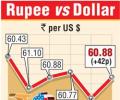
The local currency opened higher at 61.20 a dollar from the previous close of 61.30 at the Interbank Foreign Exchange Market.
A weak dollar overseas failed to restrict the rupee's decline, a forex dealer said.

The rupee appreciated by 29 paise to close at 63.38 against the greenback following fresh dollar selling by exporters.

The domestic currency had gained by 80 paise, or 1.19 per cent, in previous five trading days.

The dollar index, which measures the greenback's strength against a trade-weighted basket of six major currencies, was up by 0.19 per cent at 95.48.

Inflows from Europe, falling crude oil to come to the rescue if rupee cracks against the dollar.

Bearish greenback overseas and robust capital inflows predominantly supported the domestic currency

The rupee resumed marginally lower at 67.24 per dollar against Wednesday's closing level of 67.21.

The rupee had gained by 50 paise or 0.75 per cent in two weeks.

The rupee declined marginally by 3 paise to 66.03 per dollar on fresh demand for the US currency from banks and importers.

India's sad export figure put pressure on the rupee

The dollar's weakness against some currencies overseas limited the rupee's fall.

HCL Tech led the Sensex gainers' chart, spurting 3.58 per cent, followed by UltraCement, Nestle India, Tata Steel, Kotak Bank, ICICI Bank, Bharti Airtel and HDFC twins. In contrast, ITC, Maruti, NTPC, Asian Paints and Sun Pharma were among the main laggards, shedding up to 1.51 per cent.

Tracking local stocks, rupee on Tuesday regained 19 paise to end at 61.85 against dollar as reports of easing geopolitical tension between Russia and Ukraine helped emerging market currencies script a smart recovery.

The Indian unit opened sharply higher at 64.80 as against Wednesday's closing level of 65.12.

The rupee on Thursday appreciated 20 paise to end at 62.37, its highest in two weeks, on positive trends in local equities and fresh dollar selling by exporters.

IndusInd Bank was the biggest loser in the Sensex pack, shedding 7.46 per cent, followed by SBI, Tata Motors, M&M, Bajaj Finserv, Axis Bank and Infosys. In contrast, Tech Mahindra was the only winner.

Reflecting nervousness over the prospect of the Federal Reserve tightening policy and event risk, traders stayed on the sidelines

The rupee is expected to become more jittery and choppy in the near-term

Strong month-end demand for the US currency mainly from oil importers along with currency futures expiry related purchases predominantly weighed heavily on the forex market and haunted investor sentiment.
The US dollar index, which tracks the greenback against a basket of six major currencies, was 0.38 per cent lower at 95.41.

The rupee had recovered by 8 paise to close at 66.91 in Tuesday's trade.

The rupee has dropped by 21 paise or 0.32 per cent in the last two sessions.

A firming trend in domestic stock markets, however, capped the rupee fall to some extent

Equities are the go-to asset class as far as ultra-long-term returns are concerned. Over the past 123 years, global equities have provided an annualised real return of 5 per cent in US dollar terms, while bonds have delivered 1.7 per cent and short-term bills just 0.4 per cent, according to Credit Suisse's Global Investment Returns Yearbook 2023. In collaboration with the London Business School, Credit Suisse has analysed over 100 years of returns for key asset classes in 35 countries.

Investors are anxious over the US-China trade tension, a sharp devaluation in yuan and uncertainty over Kashmir issue.

Sliding for the fourth straight day, the BSE Sensex shed 152 points in choppy trade on Wednesday amid mixed global cues ahead of the US Federal Reserve's policy decision.

Lacklustre domestic equities alongside ongoing FCNR redemptions added pressure on the local currency

The home currency failed to keep momentum going and largely traded in a narrow range with positive bias in the absence of any market moving factors

Have the markets already played out their dynamics before the economy has even properly taken off? Are we now destined for a period of mediocre returns despite a strong economy? asks Akash Prakash.

Equity benchmarks Sensex and Nifty gave up early gains to close in the red on Wednesday after a selloff in power, metal and consumer durable stocks amid a weak trend in global equities. However, a rally in the rupee against the US dollar and unabated foreign capital inflows helped the indices restrict the losses, traders said. In a largely range-bound session, the 30-share BSE Sensex ended 151.60 points or 0.25 per cent lower at 61,033.55.

The rupee slipped from its initial gains by 5 paise against the US currency to 67.89 in late morning deals on bouts of dollar demand from importers.

RBI fixed the reference rate for the dollar at 66.2930 and euro at 74.8978.

The rupee recovered 14 paise to 66.40 against the dollar in early trade on Monday.
